

Under 10 (Green to yellow)- 1st Month Raising a Champion
PreviewProgression week 1 to 4 : Master the baseline
Content includes:
- Recomended material and court size.
- Objectives to accomplish. 1 goal a week.
- Challenges to accomplish by players 1 a week.
- Proposed sesion plan to be worked during 1 week, (3 to 8 players on court)
- Coach’s guide: technical, tactical, mental and physical abilities
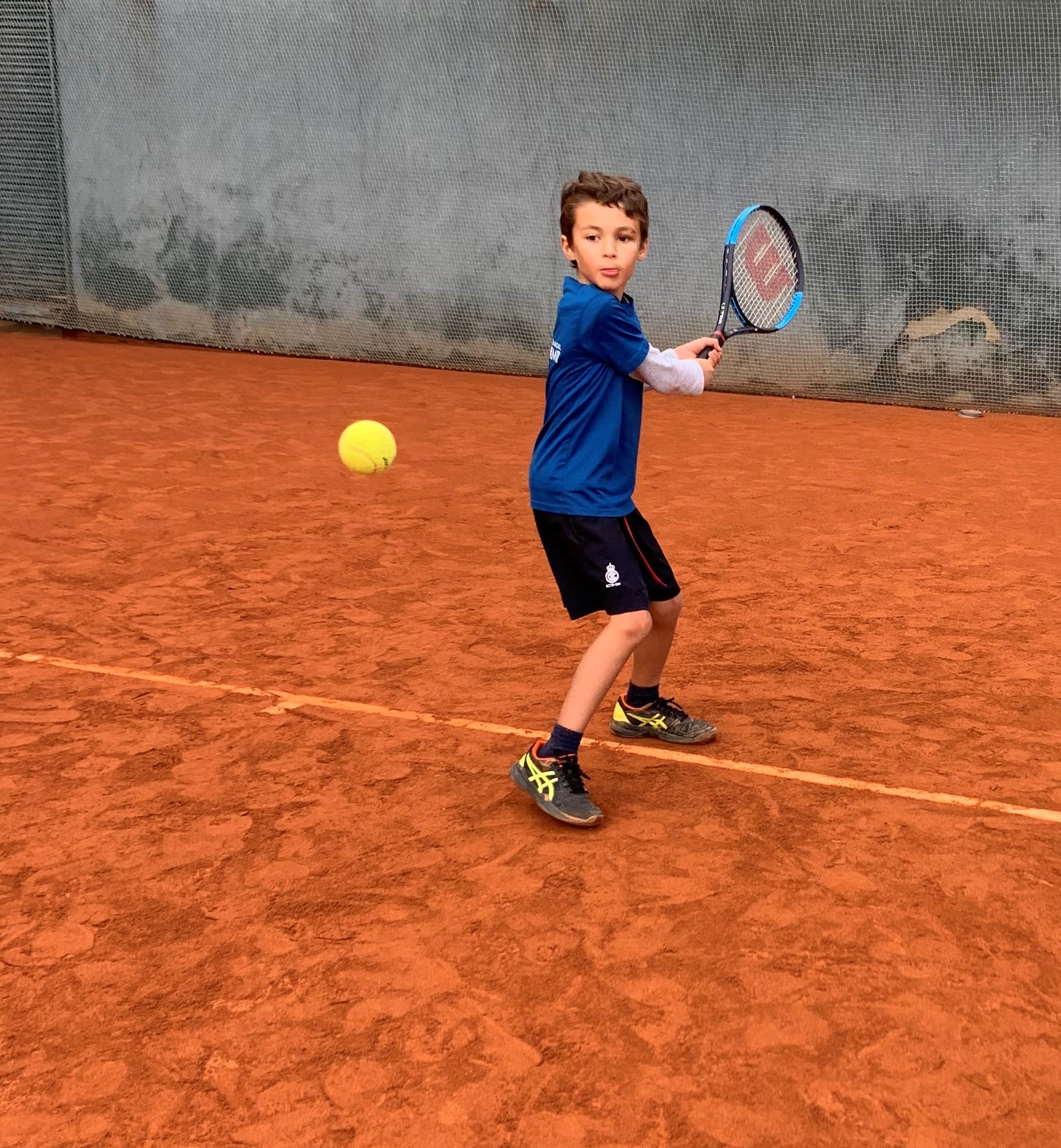
Material and court
Court progression:
Player at this stage are ready to consolidate rally from the baseline (23 m).
Racquet:
When playing from the baseline with green balls players must acquire a racquet between 66 and 67,5cm and made with a mixture of fibers (mainly graphite). Rcomended weight between 250-265 grams.
Balls:
The balls have to allow players to contact between hip and shoulder. At this stage the players have to consolidate the rally from the baseline using the green dot ball.


Content
Week 1: Building the forehand as a weapon (in comfortable position)
Goals:
Technical concept:
- Forehand motion with semi flat ball impact, using close stands with minimum movement towards the ball.
- Grip: Between eastern and semi-western.
- Shot Preparation: Racket head pointing sky.
- Backswing: Head of the racquet above the hand.
- Contact: Hitting in front of the body, between hip and shoulders and head of the racquet under de hand.
- Stroke finish: grabbing the racket with the non-dominant hand.
2. Service swing over the head without jump (just raising the back heel). Make serves from the baseline)
Week 2: Building the forehand as a weapon (with movement)
Goals:
Technical concepts:
- Forehand adjustment: forehand stroke with semi flat ball impact, increasing the movement in approaching the ball.
- Contact between hip and shoulder.
- Ball’s perception (deep and short)
- Diagonal movements (in and out of the court)
- Work on close, semi open, or open stands
- Recoveries and waiting position
Tactical concept
- Gain control of the stroke’s strength direction and height
- Gaing control of stroke’s parabolic trajectory
Week 3: Building the backhand as a weapon (in comfortable positions)
Week 3: Building the backhand as weapon (in comfortable positions)
Technical Concept:
- Two-handed backhand swing: Stroke with flat ball impact, using
close stands and minimum movement towards the ball.- Grip, dominant hand (continental) non dominant hand (Este) .
- Shot Preparation: Racket head pointing sky.
- Backswing: Head of the racquet above the hand.
- Contact: hitting in front of the body, between hip and shoulders and head of the racquet under de hand.
- Stroke finish: extending the non-dominant hand, without passing the back foot.
Week 4: Building the backhand as a weapon (moving)
Goals:
Technical Concept:
- Backhand adjustment: stroke with flat ball impact, increasing the movement in approaching the ball.
- Contact between hip and shoulder
- Ball’s perception
- Diagonal movements (in and out of the court)
- Work on close and open stands
- Recoveries and waiting position
Tactical concept
- Gain control of the stroke’s strength direction and height
- Gaing control of stroke’s parabolic trajectory
Coach’s support (example of session’s excercises)
Warm up
Using half court down-the-line, maintain a forehand
and backhand rally trying to get the ball to bounce inside the
service box.
Wheel forehand rally
Rally in wheel form. The coach puts the ball in play
and two players maintain a rally from the back of the court
hitting once each player only with forehand
Rally with the Backhand
Rally (hitting backhand only). On half court down-the-line, the coach from the volley, rallies with the players.
Forehand rally and inside out
Using half court crosscourt, the coach rallies from
the baseline with a student who hits forehand crosscourt. On
the other half court, two students maintain a rally hitting with
inside out forehand. The waiting players are at the net posts
and enter at the first miss of one of their classmates. The player
who misses goes to the post.
Basquet drill forehand (movement)
The coach throws from the cart, alternating, one ball
to each of the students on the court who hit, after moving
(laterally or diagonally, forward or backward), towards the
doubles alley. After each hit, the player must always return to
the original position.
Basquet drill forehand (movement)
The coach throws from the cart, alternating, one ball
to each of the students on the court who hit, standing still,
forehand direction to the doubles alley. There are
four players in two lines who hit in wheel form. After the hit, the
student must touch the back fence with their racket. .
Game “Trio”:
DESCRIPTION:
PLAYERS: Two players against one. The pair cannot hit towards the doubles alley but the individual player can. The goal is to try to maintain the individual’s player position.
STARTING POSITIONS: At the baseline there is one player playing and two waiting, at the other baseline there are two players playing and one waiting.
GAME START: The coach puts the ball in play to either one of the players.
CHANGING POSITIONS: If the individual player wins the point then that player maintains the individual position. The pair steps out of play so that the trio can enter. If the individual player loses the point, then that player also loses the individual position and changes quickly with the player from the pair who won the point. (While they change positions, the trio who was waiting enters).
SCORING: Only the individual position makes points and the first player to make 7 points wins.
Game “Grand Slam” single:
DESCRIPTION:
PLAYERS: Played in singles. The players choose to play one of the four Grand Slams: (Wimbledon, Roland Garros, US Open or Australian Open)
STARTING POSITIONS: Two players are at the baseline of the court, the coach is at the net post, and four players are waiting in a line at the other net post.
GAME START: The coach puts the ball in play to one of the two players.
CHANGING POSITIONS: The player who wins the point maintains his position. The player who loses the point goes to the post and gives up their place to a team-mate who comes running from the post and hits the ball thrown by the coach.
SCORING: The score is kept like winning rounds in a tournament. Counting begins from round of 32, then if the player wins, he goes on to round of 16, then if he wins he passes to quarterfinals, then if he wins he passes to semi-finals, then if he wins he passes to the final, and if he wins the final he wins the tournament. If a player loses the point, he is last in line at the post and begins again from round of 32.
No Comments