

1 – Warm up for 4 to 6, or 6+ players.
Free PreviewContents
Description:
The coach organizes the space according to the activity he wants to do and the number and level of his players.
Goal of the activity
In the technical warm-up, the player must progressively get good sensations in his shots and focus his attention mainly on the hitting technique.
Planning of the session:
Defined by the coach
Organization and development:
The court is divided into two parts and the 4 players start a parallel rally in pairs (doubles warm-up style). So that there are no interruptions to the game, each player must start each series with two balls (stored in their respective pockets), once the series of 4 balls ends, the next one is restarted with another series of 4 more balls.
Changes of position: The coach can ask the players to exchange hitting partners every 5-10 minutes, so all players hit with each other. An important fact to consider is that in every group of 4 players, there will be players of higher and lower level of play. The idea is to adjust the hitting partners in a way that the highest level player never hits with the lowest level player.
Coach’s task:
The coach gives the players some autonomy and reduces the involvement to giving some pieces of advice on continuity of the exercises, rhythm, positioning on court, and feedback. The players take responsibility of performing at a high intensity, evaluating their progress and learning to give feedback to the coach.
Player role:
Find the practical answer to the situation.
Practical examples
Warm up and rallies with 4 players:
“Warm Up with 4 Players on court” : During the initial warm up, the players have to find a good rhythm and good sensations with their strokes and focus their attention on a proper technique. In this case the players focus their attention on stroke accuracy, trying to hit the ball inside the doubles alley.
Position changes: in order to add some variation to the exercise, the court can be divided in 2: a “Winners’ Alley” and a “Losers’ Alley”. The players compete by trying to hit as many shots as possible inside the doubles alley, the players that get less shots in – move down, the ones that get more shots in – move up.
Variants: The players hit: forehand against forehand, backhand against backhand, forehand against backhand, etc. One more variation can be that if the ball bounces short (before the service line) it is considered “Out”.
Warm up and rallies for 6 players (+12 years old):
“Warm up with 6 Players on court” (Recommended for players older than 12 years) In this set up, the intensity of the exercise is higher because the intervals between points decrease, but there is a higher risk of a player getting hit while waiting to play. It is recommended to reinforce that the player that is waiting is positioned in the middle of the back fence of the court, far away from the action (the use of cones or targets to specify the waiting position is advised).
Organization: 4 players hitting down-the-line forehands and backhands, 2 using one half of the court – 2 using the second half; 2 players waiting in the middle of the back fence – always ready with a ball in hand.
Position changes: the player that is waiting takes the place of one of the players hitting, whenever one of them makes a mistake (on the same side of the court).
Warm up and rallies 6 Players (- 12 years old):
“Warm up with 6 Players on court” (Recommended for players 12 years and younger) In this set up, to reduce the risk of a player getting hit while waiting to play, it is recommended to reinforce that the player that is waiting is positioned at the net post, away from the action (racket swings).
Organization: 4 players hitting down-the-line forehands and backhands, 2 using one half of the court – 2 using the second half; 2 players waiting at the net posts – always ready with a ball in hand.
Position changes: the player that is waiting takes the place of one of the players hitting, whenever one of them makes a mistake (on the same side of the court). Variants: The players try to play in the doubles alleys: forehand against forehand, backhand against backhand, forehand against backhand, etc. One more variation can be that if the ball bounces short (before the service line) it is considered “Out”.
Warm up and rallies + 6 players in 2 courts:
“Warm up with 6+ Players on 2 courts” In this set up, the coach works simultaneously with 8 players on 2 courts. The best position to have general visual overview of both courts is standing in the back fence between the 2 courts; this way the coach can manage and advise players from both courts as needed.
Organization: 6 players hitting (2 players on 3 halves of a court) down-the-line forehands and backhands; 2 players waiting in the middle of the back fence – always ready with a ball in hand.
Position changes: the player that is waiting takes the place of one of the players hitting, whenever one of them makes a mistake (on the same side of the court).
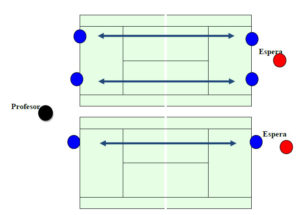
“Warm up with 8+ players on 2 courts” both courts are divided in halves; 8 players hitting down-the-line (2 players on 4 halves of a court) and the rest of the players wait at the back fence or at the net post.
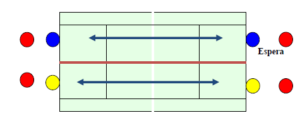 “Warm up with 8 players on court” the court is divided in 2 halves; on each 1/2 of the court: 2 players hitting down-the-line and the rest of the players wait at the back fence or at the net post, with a ball in hand, ready to play whenever a player makes a mistake.